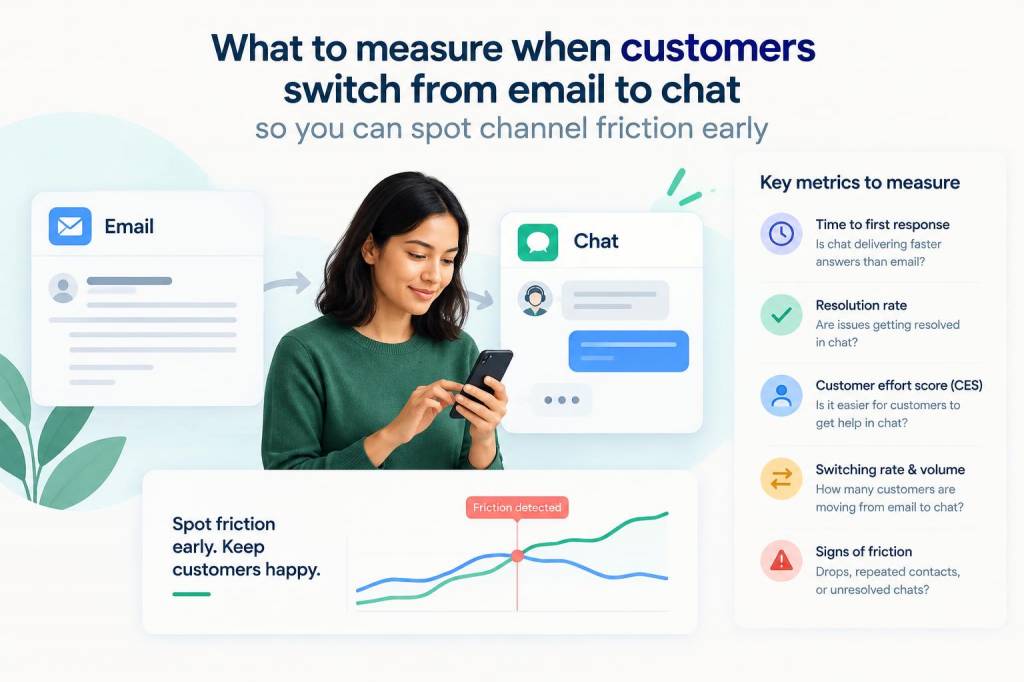
When I look at customer journeys across support channels, one pattern stands out very quickly: a switch from email to chat is rarely random. It usually means something in the experience has created pressure. Maybe the issue is urgent, maybe the customer has lost confidence that email will resolve it, or maybe they simply cannot find a clear next step. Whatever the reason, that channel jump is a signal I want to understand early, because it often reveals friction long before it turns into churn, complaint volume, or a broken service journey.
What I measure in those moments is not just whether a customer moved from one channel to another. I want to know why they moved, how quickly they moved, what happened before the switch, and what happened after. If I track the right indicators, I can tell whether the switch was a healthy preference for a faster channel or a warning sign that email support failed to meet expectations.
Why channel switching matters more than many teams realise
In a perfect service model, customers choose the channel that fits their need and stay there long enough to get an answer. In reality, people move when the experience creates doubt, delay, or extra effort. A customer who starts in email and then jumps into chat may be saying, without words, that they do not trust the current path to resolution.
I have seen this happen in all kinds of situations: billing confusion, login problems, shipping delays, refund requests, and account access issues. Sometimes the customer simply wants speed. Other times, the email thread has gone stale, the answer was unclear, or the agent did not ask for the right information up front. The danger is that many teams record the contact as a normal chat interaction and miss the earlier friction entirely.
That is why I prefer to treat channel switching as a journey signal, not just an operational detail. Once I measure it properly, I can connect it to response times, resolution quality, self-service gaps, and even product or policy confusion.
My first priority: measure the trigger before the switch
If I want to spot friction early, I start with the event that preceded the move to chat. I ask what happened in email before the customer switched. Did they wait too long for a reply? Did they receive an answer that created more questions? Did they have to repeat information? Did the conversation stall after one back-and-forth?
The most useful measures here are:
- First response time in email, especially by issue type
- Time to next customer action after each email reply
- Number of email back-and-forths before chat starts
- Email reopen rate for cases that later move to chat
- Subject-to-chat conversion rate, meaning how often a given topic shifts channels
I pay close attention to the gap between the last email agent action and the chat start. If that gap is short, the customer may have been dissatisfied with the reply. If it is long, the customer may have waited until frustration built up. Either way, the timing tells me something important about the experience.
Response delay is not just a speed metric
Many support teams monitor response time, but I find that raw speed alone can be misleading. A fast first reply does not mean the issue was handled well. A customer may still switch to chat if the answer was vague, generic, or incomplete. For that reason, I look at response delay alongside reply usefulness and conversation progress.
One metric I like is the percentage of email threads that receive a follow-up chat contact within a defined window, such as 24 hours or 72 hours. If that percentage is high for a specific topic, I know the original email flow may be failing to create confidence. I also compare the switch rate against service level targets. If email is meeting the target but customers still jump to chat, the issue is not simply speed. It may be clarity, ownership, or resolution quality.
I also watch whether the switch happens after an out-of-office period, a queue delay, or a complex internal handoff. Those patterns often point to weak continuity rather than weak intent.
What the chat message reveals about friction
Once the customer reaches chat, I do not stop measuring. In fact, the first few chat messages can tell me whether the friction is being resolved or amplified. I want to know whether the customer repeats the same issue, introduces new context, or expresses frustration about the earlier email exchange.
Some of the most revealing measures are:
- Repeat information rate, meaning how often the customer has to restate the issue
- Sentiment shift from email to chat
- Escalation language such as “still waiting,” “nobody answered,” or “I need this now”
- Agent clarification count in the first chat interaction
- Transfer rate from chat to another team after the switch
If the customer comes into chat angry, confused, or already asking to escalate, that is a strong signal that the journey has broken down earlier than the chat itself. I also listen for signs that the customer used chat because email felt too slow for the urgency of the issue. That distinction matters. Urgency without frustration can be healthy. Frustration without urgency is a much stronger sign of friction.
Resolution quality tells me whether the switch helped
A channel switch is only useful if it improves the outcome. So I always track whether the chat interaction actually resolved the problem faster or better than email would have done alone. If customers switch to chat and still need multiple contacts, that tells me the system is not absorbing friction effectively.
My preferred outcome measures include:
- First contact resolution after switch
- Time to resolution from original email start
- Case closure rate after chat
- Customer satisfaction after cross-channel resolution
- Recontact rate within seven days
I find the total time from first email to final resolution especially useful. A customer who moves from email to chat and gets helped quickly may still have experienced friction, but at least the organisation recovered well. A customer who switches channels and still waits days for a resolution is telling me that the issue is systemic.
I segment by issue type, because averages hide the real story
If I only look at overall switch rates, I can miss the real source of friction. Some issue types naturally lend themselves to chat, while others should be handled easily in email. That is why I segment by reason for contact, product line, customer tier, and language when possible.
For example, I often see higher email-to-chat switching for urgent account access problems than for simple address updates. That makes sense. But if I see a high switch rate for straightforward requests, I know something is wrong with the workflow. Maybe the confirmation emails are unclear. Maybe customers cannot find the right form. Maybe the initial reply is too scripted.
I also compare switch patterns across customer segments. New customers may switch because they need reassurance. Long-term customers may switch because they expect faster handling. High-value accounts may use chat because they want immediate acknowledgement. Those differences help me tell preference apart from frustration.
Operational signals I use to detect hidden friction early
Beyond the obvious journey metrics, I look for operational signals that often sit just beneath the surface. These signals help me spot trouble before contact volume spikes.
| Signal | What I look for | What it may mean |
|---|---|---|
| Short email thread, fast chat switch | Customer moves after one reply | Answer may be unclear or unhelpful |
| Long email delay, then chat | Customer waits, then changes channel | Service speed may be below expectation |
| Repeated details in chat | Customer restates account or issue | Context is not passing cleanly across channels |
| High switch rate for one topic | Specific issue keeps crossing channels | Process, content, or policy may be weak |
| High chat escalation after email | Chat cannot resolve the case either | Root cause may require deeper fixes |
I also watch for peaks in switch activity after product launches, policy changes, billing runs, and outage events. Those moments often expose friction that normal operations conceal. If the switch rate rises right after a change, I treat that as an early warning, not a coincidence.
What I do with the data once I spot a pattern
Measurement only matters if it leads to action. When I see repeated email-to-chat switching, I usually start by reviewing the language and structure of the original email response. I want to know whether the answer was complete, whether the next step was obvious, and whether the customer was given a realistic timeline.
I also work with service and product teams to ask a few direct questions:
- Did the email response create enough clarity for the customer to continue without help?
- Was the channel choice appropriate for the type of issue?
- Did the customer have to search for another route because the first one felt too slow?
- Was the chat team receiving enough context from the email interaction?
- Is there a policy, workflow, or product issue creating repeat contact?
When I find a pattern, I do not treat it as a support problem alone. I often find that friction sits at the intersection of product design, policy wording, automation logic, and service operations. That is why the strongest fixes are usually cross-functional. A better reply macro may help, but a clearer refund policy or smarter routing rule may matter even more.
My practical metric set for email to chat switching
If I had to build a compact dashboard for this journey, I would include a focused set of metrics that show both volume and quality:
- Email-to-chat switch rate by issue type
- Median time from email start to chat start
- Percentage of switches after first reply
- Repeat contact rate after chat
- Resolution time from first contact to closure
- Customer satisfaction after cross-channel journeys
- Sentiment change between email and chat
- Escalation rate following a channel switch
I would not use these metrics in isolation. I would pair them with customer comments, agent notes, and topic tagging so I can understand the experience behind the numbers. That combination is what lets me detect friction early instead of reacting after customers have already become dissatisfied.
When customers switch from email to chat, I see an opportunity to learn where the journey is breaking down. The switch itself is not the problem; the hidden strain behind it is. By measuring response timing, repeat effort, sentiment changes, resolution quality, and issue-specific patterns, I can see where customers are losing confidence and where my service design needs attention.