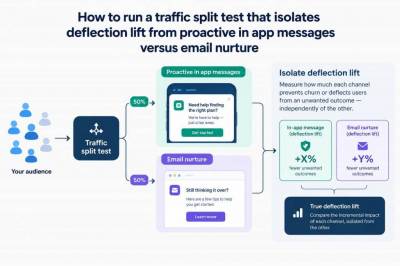
When I help teams measure the true impact of proactive channels—like in-app messages versus email nurture—the trickiest challenge is isolating deflection lift. In plain terms: how many support contacts did you avoid because you reached customers proactively, rather than because of general...
Read more...

I’ve spent years combing through mountains of agent and bot transcripts — chat, email, social, SMS, voice-to-text — looking for the subtle patterns that quietly push conversations toward costly escalations. Those triggers are rarely dramatic: they’re buried in phrasing, timing, handoffs and...
Read more...

When a leadership team asks me whether they should replace phone support with asynchronous chat, the real question is rarely about preference. It’s about money, capacity, and customer experience. The word “replace” hides a lot of trade-offs: cost per contact, resolution time, customer...
Read more...

I’m going to show you a practical, low-friction way to tag and quantify emotional effort in support tickets using only the fields you already have and three simple NLP rules. This is not a research paper or a deep-learning play—it's a method you can implement in a week, iterate on with real...
Read more...

I recently ran a seven-day sprint to measure the true ROI of a GPT-assisted agent workflow, and I want to share the exact approach I used so you can replicate it. When vendors promise “faster replies” and “higher CSAT” with large language models (LLMs), what they rarely provide is a simple,...
Read more...
When you update your knowledge base, how do you know whether that work actually reduced incoming contact volume — and which channels benefited? I’ve spent years helping support teams move from intuition to measurable outcomes, and one of the most reliable levers is tracking deflection...
Read more...

I want to walk you through a practical, lightweight approach I’ve used to catch problems early in chat channels: a three-metric early-warning system derived from chat transcripts that predicts when a conversation is likely to escalate or when a customer will reopen a ticket. This isn’t an...
Read more...

Every support leader I’ve worked with wants the same thing: to know about a problem before it becomes a trend. Dashboards that show churn rising a week after the fact are useful — but they’re not useful enough. What I build instead are nightly analytics pipelines that surface rising churn...
Read more...

When teams talk about "reducing effort" in support, they usually mean time saved or fewer touches. Those are important, but they miss a critical dimension: emotional effort — the cognitive and emotional work a customer does to get unstuck. I've spent years watching support journeys and the worst...
Read more...
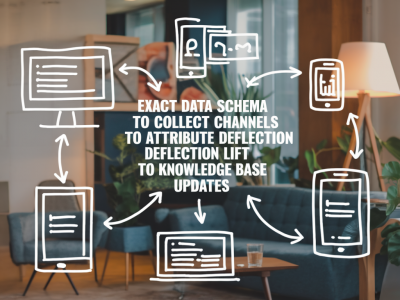
In my experience, one of the trickiest measurement problems in digital support is proving that knowledge base updates actually cause deflection lift. Teams often have the intuition—searches drop, contact volume falls—but without a consistent event schema across channels it's nearly impossible...
Read more...