When I build a QA scorecard, I do not start with the form. I start with behavior. I want to know which customer moments actually shape loyalty, repeat purchase, and churn risk. A scorecard that only measures compliance or script usage may tell me whether an agent followed process, but it rarely tells me whether a customer felt understood, whether the issue was solved fast enough, or whether trust survived the interaction.
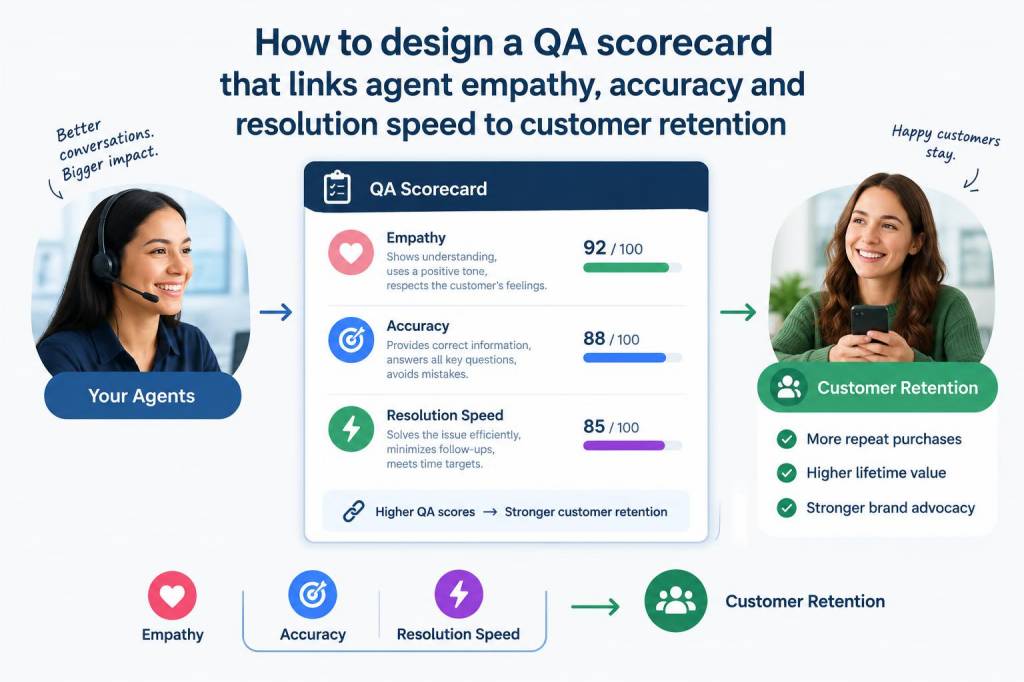
That is why I design QA around three linked outcomes: empathy, accuracy, and resolution speed. Each one matters on its own, but retention improves only when they work together. In my experience, a customer does not stay loyal because an agent was fast but cold, or warm but wrong, or accurate but painfully slow. Retention grows when customers feel heard, receive a correct answer, and get closure without unnecessary friction.
Start with retention, not with agent behavior
One of the biggest mistakes I see is teams building scorecards from internal assumptions. They add ten or fifteen criteria because every department wants a checkbox. Finance wants compliance. Operations wants efficiency. Support leaders want consistency. Everyone gets a field, and soon the scorecard becomes a reporting artifact rather than a performance tool.
I prefer to reverse the logic. I ask: which support behaviors are most likely to influence retention in our business? If I am working with a subscription product, I may care deeply about first contact resolution, confidence in answers, and the tone of cancellation conversations. If I am supporting a high-value service, I may care more about ownership, reassurance, and follow-through. The scorecard should reflect customer economics, not internal politics.
When I set this up, I map a few business questions first:
Those answers help me decide which quality behaviors deserve weight. A retention-linked QA model should reward actions that reduce effort, protect trust, and remove uncertainty.
Define empathy in observable terms
Empathy can become vague very quickly. If I simply write “agent showed empathy,” reviewers will score based on mood, personal taste, or a vague sense of kindness. That creates inconsistency. Instead, I define empathy through visible behaviors that a reviewer can actually hear or read in the transcript.
For me, strong empathy usually includes a mix of acknowledgment, ownership, and reassurance. I listen for whether the agent recognizes the customer’s emotion or inconvenience, whether they avoid defensive language, and whether they set a clear path forward.
Examples of observable empathy behaviors I often include:
I like to score empathy with a small set of levels rather than a binary pass or fail. A three-point scale works well for many teams: poor, acceptable, strong. That gives reviewers enough nuance to distinguish polite but empty language from genuine reassurance.
I also separate surface warmth from effective empathy. A cheerful tone is not enough if the customer still leaves confused or unsupported. Real empathy should lower emotional friction and move the case toward resolution.
Treat accuracy as a trust signal
Accuracy is not just about correctness in a technical sense. It is a trust signal. When an agent gives a wrong answer, even if the tone is kind, the customer learns that they cannot rely on support. That damages confidence and increases repeat contacts, escalations, and poor reviews.
I like to break accuracy into several dimensions:
In some teams, accuracy gets overweighted because it is easy to measure. I understand why, but I do not let it dominate the scorecard. A technically correct answer delivered with no empathy may still drive churn. At the same time, strong empathy with a wrong answer can create false confidence, which is even more dangerous. That is why I treat accuracy as a core pillar rather than a final catch-all.
When I calibrate reviewers, I use sample interactions with known outcomes and ask a simple question: would this answer give the customer confidence to act? That framing helps reviewers move beyond rule-checking and think about business impact.
Measure resolution speed in a way that reflects customer effort
Speed matters, but raw handle time can mislead. A short interaction is not always a good interaction. A long interaction is not always wasteful. What I care about is whether the customer reached resolution quickly in relation to the complexity of the issue.
That is why I prefer a broader view of resolution speed:
If I see a team optimizing only for short calls or short chats, I usually find hidden friction somewhere else. Agents may rush, transfer too early, or avoid taking ownership. That may improve one metric while quietly hurting retention.
For the scorecard itself, I often make speed a weighted dimension rather than the main event. In many customer care environments, a fast but incomplete resolution is a false win. I want the scorecard to reward efficient closure and low-effort experiences.
Connect quality signals to retention signals
This is where the scorecard becomes genuinely useful. If I cannot link QA results to customer retention outcomes, I am only measuring internal performance. To make the model useful, I connect quality scores with downstream metrics such as renewal, repeat purchase, case reopen rate, and customer sentiment.
In practice, I look for patterns like these:
I do not need perfect causation to make the scorecard valuable. Correlation is enough to start improving behavior. Over time, I can test whether specific QA dimensions predict retention more strongly than others. That gives me a stronger case when I need to adjust coaching, staffing, or process design.
One practical method I use is cohort analysis. I compare customers who experienced high-quality support with those who did not, then track retention over a fixed period. Even a simple version of this exercise can reveal whether my QA scorecard is aligned with business outcomes.
Balance weighted scoring with a few non-negotiables
A retention-focused scorecard needs both flexibility and discipline. I usually combine weighted scoring with a few critical fail items. Weighted scoring helps me reflect business priorities. Non-negotiables protect against serious mistakes.
For example, I might give empathy 30 percent, accuracy 40 percent, and resolution speed 30 percent. But I may also define critical failures such as inaccurate safety information, broken policy, or hostile language. If one of those occurs, the interaction fails regardless of the total score.
This approach works because not every error has equal impact. A slightly clumsy transition sentence is not the same as a wrong refund promise. A slow reply may be acceptable in a complex escalation if the customer stays informed. A misleading answer, however, can undo every other positive behavior.
| Dimension | What I Measure | Retention Impact |
|---|---|---|
| Empathy | Acknowledgment, tone, ownership, reassurance | Trust, emotional calm, lower complaint risk |
| Accuracy | Correct answers, policy adherence, clear documentation | Confidence, fewer repeat contacts, fewer errors |
| Resolution speed | Time to useful response, time to resolution, effort reduction | Convenience, lower friction, stronger loyalty |
Keep the rubric simple enough for consistent coaching
If a scorecard is too complex, reviewers drift. Agents lose trust in the process, and managers spend more time debating scores than improving service. I try to keep each category readable in under a minute.
A useful rubric usually includes:
I also avoid language that sounds punitive. If the scorecard reads like a compliance audit, agents will treat it like one. I want it to feel like a performance development tool. That means I write criteria in a way that encourages growth: “sets clear next steps,” “confirms understanding,” “provides accurate guidance,” and “reduces customer effort.”
When I review with teams, I show them not just the score, but why a score matters. That helps agents understand the link between behavior and retention. Once they see that connection, coaching becomes more meaningful and less abstract.
Use QA results to shape coaching, not only reporting
A scorecard only creates value when it changes behavior. I use QA data to identify individual coaching needs, but I also look for systemic patterns. If many agents lose points on empathy during billing disputes, the problem may not be the people. It may be a missing policy explanation, a confusing workflow, or a poorly designed macro.
That is why I treat QA as a diagnostic tool. I ask:
Once I find the pattern, I can coach more precisely. Sometimes the answer is training. Sometimes it is knowledge base design. Sometimes it is better case ownership. And sometimes it is simply giving agents permission to slow down when a customer needs real attention.
That is the real strength of a QA scorecard linked to retention: it helps me move from abstract service quality to specific operational fixes that customers actually feel.