When I want to uncover what is quietly driving repeat contacts, I start with transcripts before I touch dashboards. Volume charts tell me where activity is rising, but transcript clustering tells me why. That difference matters. A contact center can look healthy on paper while customers keep coming back for the same unresolved friction, and those repeated contacts are often hiding in plain sight inside chat logs, call transcripts, email replies, and case notes.
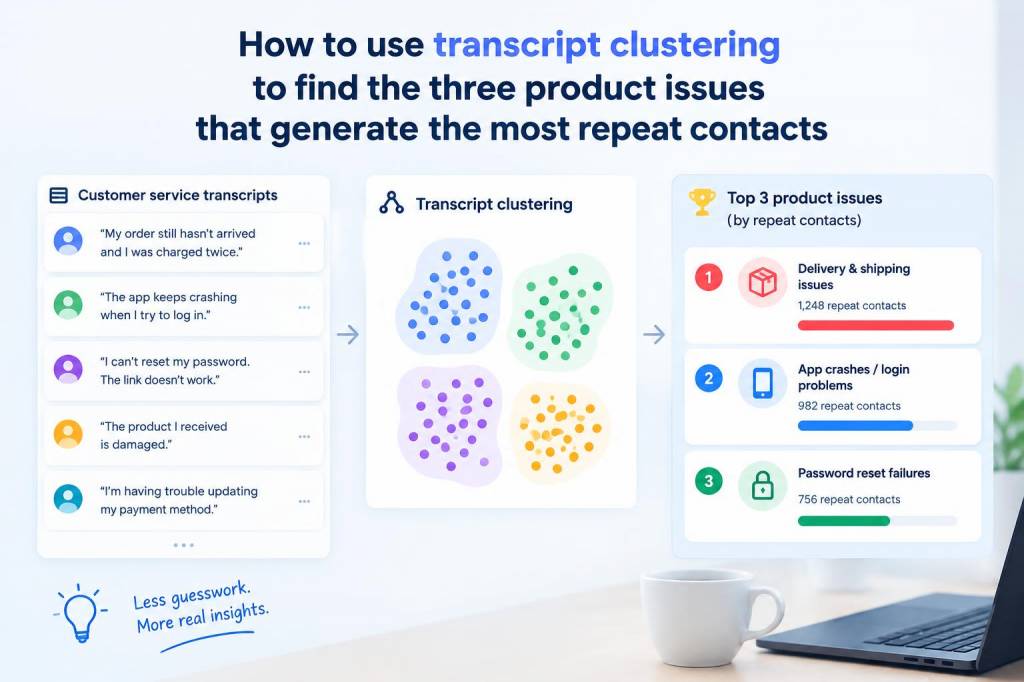
Transcript clustering is my favorite way to turn thousands of messy conversations into a short list of issue themes that actually matter. It helps me move from “we have too many contacts about billing” to “these three product issues are creating most repeat contacts, and two of them are fixable without a major roadmap change.” That is a much more useful starting point for support leaders, product teams, and CX analysts.
Why repeat contacts deserve more attention than raw contact volume
Not every contact is a problem. Some customers reach out for reassurance, some need a one-time explanation, and some simply prefer human help over self-service. Repeat contacts are different. When a customer returns more than once for what should have been a single resolved issue, I see a signal of friction somewhere in the journey.
That friction may come from confusing product behavior, incomplete help content, weak agent handoffs, hidden workflow bugs, or customer expectations that are not being met. If I only count contact reasons at a surface level, I often miss those patterns. Transcript clustering lets me group similar language across conversations, then look for clusters that appear again and again in repeat-contact cases. Those clusters usually reveal deeper operational or product issues than a standard reason code ever would.
What I care about most is not just which issue is common, but which issue drives customers to come back again. That is where transcript clustering becomes especially valuable.
What transcript clustering actually means in practice
In simple terms, transcript clustering means collecting a set of conversation transcripts, converting them into text features, and grouping similar conversations together based on language, intent, and context. I do not rely on perfect manual tagging for this stage, because manual tags are often too narrow or too inconsistent to reveal emerging patterns.
There are many ways to cluster transcripts. In practice, I usually work with a blend of semantic similarity, keyword patterns, and issue metadata. A clustering model might place together transcripts that mention login failures, password resets, verification loops, or device-switch problems, even if customers describe them in different words. Another cluster might combine conversations about refunds, duplicate charges, failed cancellations, or missing confirmations if they are all symptoms of one billing workflow problem.
I usually start with a simple principle: if two customers are describing nearly the same pain in different language, I want those conversations in the same cluster. Once that happens, I can measure which clusters are overrepresented in repeat contacts and which ones appear only once.
My process for finding the three issues that drive repeat contacts
I do not begin with a model and hope for insight. I begin with a question: which three product issues generate the most repeat contacts, measured by actual customer return behavior? That means I need a dataset that connects transcripts to customer journeys, not just isolated interactions.
My working process usually looks like this:
- Pull a transcript set from chat, phone, email, and ticket notes for a defined period.
- Join each transcript to customer identifiers, case history, and repeat-contact indicators.
- Clean the text by removing filler words, signatures, and system noise.
- Generate clusters based on semantic similarity and repeated issue language.
- Review cluster labels manually to make sure each group reflects a real customer problem.
- Compare each cluster against repeat-contact rates, not just total contact count.
- Rank clusters by repeat-contact contribution, not by size alone.
The ranking step is where many teams go wrong. A huge cluster may represent a common but easily solved question, while a smaller cluster may cause many customers to return three times because the issue is unresolved or poorly explained. I focus on a repeat-contact contribution score, which combines cluster size, repeat frequency, and journey impact. That gives me a much sharper view of what is truly damaging the customer experience.
Signals I look for inside a strong repeat-contact cluster
Not every cluster is worth action. When I review clusters, I look for specific signals that show a product issue is causing customers to come back.
| Signal | What I look for | Why it matters |
|---|---|---|
| Repetition of same symptom | Customers describe the same failure mode in different words | Suggests one underlying defect or confusing workflow |
| Agent workaround language | Agents explain temporary fixes or manual steps | Shows the product path is not working cleanly |
| Escalation after first contact | Customers return after being told to wait, retry, or refresh | Signals unresolved root cause |
| High emotional intensity | Frustration, confusion, or repeated “I already tried that” messages | Often linked to poor usability or broken trust |
| Cross-channel recurrence | Same issue appears in chat, email, and phone | Strong indicator of systemic product friction |
When I see several of these signals inside one cluster, I become much more confident that it represents a real product issue rather than a support training gap or random noise.
Why I never trust cluster labels without human review
Automated clustering is powerful, but it is not wise to let it speak alone. Models can group transcripts in technically correct ways that are strategically useless. For example, a cluster might combine all “account access” conversations, but inside that group there may be three very different issues: password resets, device verification failures, and locked accounts after payment failure. If I leave them bundled together, I lose the chance to identify the specific problem that is creating the most repeat contacts.
That is why I always review clusters with a human lens. I read representative transcripts from each group, check whether agents are using a shared workaround, and test whether the issue can be expressed as a simple product statement. I want each cluster to answer a sentence like:
- Customers cannot complete multi-factor authentication after switching devices.
- Refund confirmation emails are not arriving, so customers contact support again.
- Users believe a change is saved, but the interface does not persist the update.
Those statements are actionable. “Billing issue” is not. “Payment method update does not save on mobile after card verification” is much more useful.
How I separate product issues from support process issues
This is one of the most important parts of the analysis. A repeat contact cluster does not automatically mean the product is broken. Sometimes the issue is the support journey itself.
To separate product issues from process issues, I ask a few questions:
- Would the customer still need to contact us if self-service or in-product guidance were better?
- Does the transcript point to a product behavior that customers cannot control?
- Are agents repeatedly giving the same explanation because the product is unclear?
- Are customers returning because they were not given a clear resolution or timeline?
If the answer points to product behavior, I log it as a product issue. If it points to missing information, inconsistent advice, or weak closure messaging, I treat it as a service design issue. That distinction matters because it changes who needs to act.
What I do once I have the three priority issues
Once I have identified the three product issues that generate the most repeat contacts, I do not stop at a report. I turn the findings into an action plan that product, support, and CX teams can actually use.
My usual next steps are:
- Share representative transcript examples for each issue.
- Estimate repeat-contact volume avoided if the issue is fixed.
- Map the issue to product owner, support owner, and knowledge owner.
- Separate quick fixes from roadmap fixes.
- Update help content or macros if the issue needs better explanation.
- Track whether repeat contacts drop after changes are released.
I also like to create a simple before-and-after view for each issue. If a transcript cluster accounts for 18 percent of repeat contacts in one month and drops to 7 percent after a fix, that is a clear story. It is easier to secure product attention when I can connect customer language to business impact.
A practical example of what this can reveal
In one analysis I worked on, the biggest support category was account access, but transcript clustering showed three separate repeat-contact drivers inside it. One cluster centered on verification emails not arriving. Another centered on users being logged out after app updates. A third centered on customers switching devices and losing session access unexpectedly.
At first glance, those all looked like “login issues.” In reality, they were three different product and communication problems. The email issue was mostly deliverability and timing. The app update issue was a session management bug. The device-switch issue was a design gap that was not explained well anywhere in the journey.
That insight changed the response plan completely. One issue needed engineering work, one needed a lifecycle message update, and one needed clearer in-product guidance. Without clustering, all three would have stayed buried inside a broad access category.
What makes this approach worth the effort
I keep coming back to transcript clustering because it gives me a cleaner view of customer pain than reason codes alone. It helps me spot recurring product issues earlier, understand which problems are creating repeat work, and speak to product teams in language they can act on.
It also changes the internal conversation. Instead of saying support is receiving too many contacts, I can say one issue is causing customers to return because they are not getting a reliable outcome on the first attempt. That is a much stronger case for change. It turns contact data into product intelligence, and that is where analytics becomes genuinely useful for customer care.
When I am doing this work well, I am not just counting contacts. I am listening to customers at scale, finding the three issues that keep bringing them back, and showing the business exactly where friction is costing trust, time, and effort.