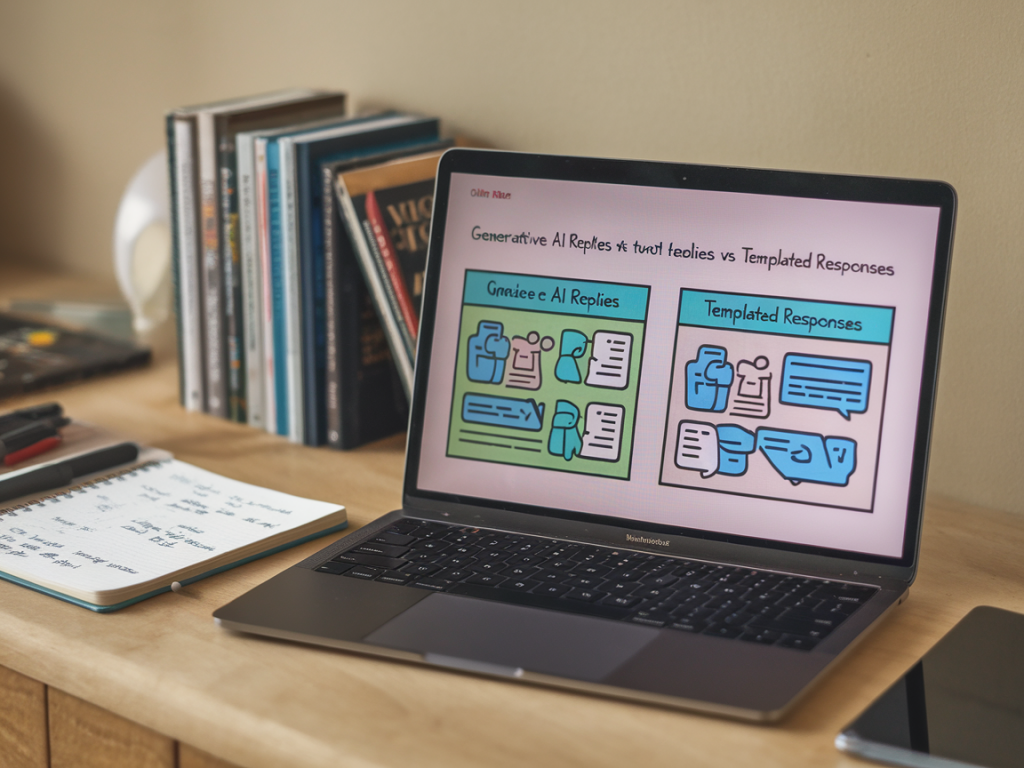
I recently ran a small experiment that tested generative AI replies against our existing templated responses. The goal wasn’t to prove one approach was universally better — it was to learn fast, protect our Net Promoter Score (NPS), and give agents and customers a clearly measurable experience. If you’re thinking about doing the same, here’s a pragmatic, lightweight A/B framework you can implement in a day or two, with minimal risk to customer satisfaction.
Why build a lightweight framework
Generative models (OpenAI, Anthropic, etc.) can produce helpful, personalized replies. Templated responses are predictable and safe. You don’t need an elaborate data-science experiment to learn which works for your use case. You do need a structure that:
This framework is intentionally minimal — it focuses on operational safety and actionable metrics rather than complex statistical modeling.
High-level design
At a glance, the experiment flow looks like this:
Choose the right scope
Pick the simplest use case where you expect generative replies could help: FAQ answers, billing clarifications, or order status checks. Avoid high-stakes areas (legal, safety, refunds involving large sums) in the initial test.
I usually start with 10-15% of traffic routed to the experiment and a further split within that for control vs test. That keeps risk low while still delivering enough volume for meaningful signal.
Routing and randomization
Randomization must be deterministic at the conversation level so a customer doesn’t see both experiences across messages. Implement routing like this:
This approach ensures a simple, reproducible sample. You can increase the window once confidence builds.
Guardrails and safety
Generative replies require guardrails. I recommend three layers:
Many platforms provide moderation endpoints (OpenAI Moderation API, Google Perspective, etc.). Even a simple keyword blocklist reduces the chance of catastrophic outputs.
Measurement plan: what to track
Keep metrics focused and aligned with protecting NPS. Track both quality and operational signals:
Focus on relative differences between GenAI and Template groups. You’re trying to detect meaningful negative impact on CSAT or increases in escalations quickly.
Stopping rules and thresholds
Define automatic stop conditions before you start. I use a mix of absolute and relative thresholds:
These rules are conservative but protect brand and NPS while letting you collect usable data.
Quick qualitative checks
Numbers tell one part of the story; sample the actual replies weekly. I set up a simple Slack feed or a dashboard that surfaces:
Reading 20-30 messages gives you a feel for tone, clarity, and whether the AI hallucinated anything. It also uncovers edge cases not visible in metrics.
Minimal statistical guidance
This is a pragmatic experiment, not a formal clinical trial. Still, basic checks help:
For example, if Template CSAT = 85% and GenAI = 80% with 500 conversations each, the 5-point gap is probably meaningful operationally even if not "statistically significant" at p<0.05. Treat it as a signal and investigate.
Example experiment plan (copy-and-use)
| Channel | Email / In-app messages |
| Traffic split | 5% GenAI, 5% Template, 90% baseline |
| Duration | 2 weeks or 1,000 convos per arm |
| Guardrails | PII/financial intents → agent. Output moderation. Agent review if confidence < 0.6 |
| Primary metrics | CSAT, Follow-up message rate, Escalation rate |
| Stop rules | CSAT drop > 10pt, escalation ↑ > 25%, >5 moderation flags / day |
Iterate fast
If the initial run shows promise, increase traffic in measured steps (5% → 15% → 30%), relax human review gradually, and use the qualitative feedback to improve prompts and safety rules. If results are mixed, experiment with hybrid approaches: generate a draft reply that a templated connector augments, or use GenAI only to suggest personalization tokens while sending template body.
Running a lightweight A/B framework like this gives you three things: evidence you can act on, minimized risk to NPS, and a repeatable process for scaling AI-driven replies. I’ve used this pattern across multiple teams and it’s allowed us to safely explore generative models while keeping customers and agents comfortably in the loop.