When I started helping support teams shift from channel-based organisation to outcome-focused squads, I expected resistance — but what surprised me most was how often teams hadn’t even agreed on the outcomes they were trying to deliver. Channels are easy to see: you can count phone lines, chat sessions, and inboxes. Outcomes are messier because they require judgement, measurement, and cross-functional collaboration. That messiness is where the value lives.
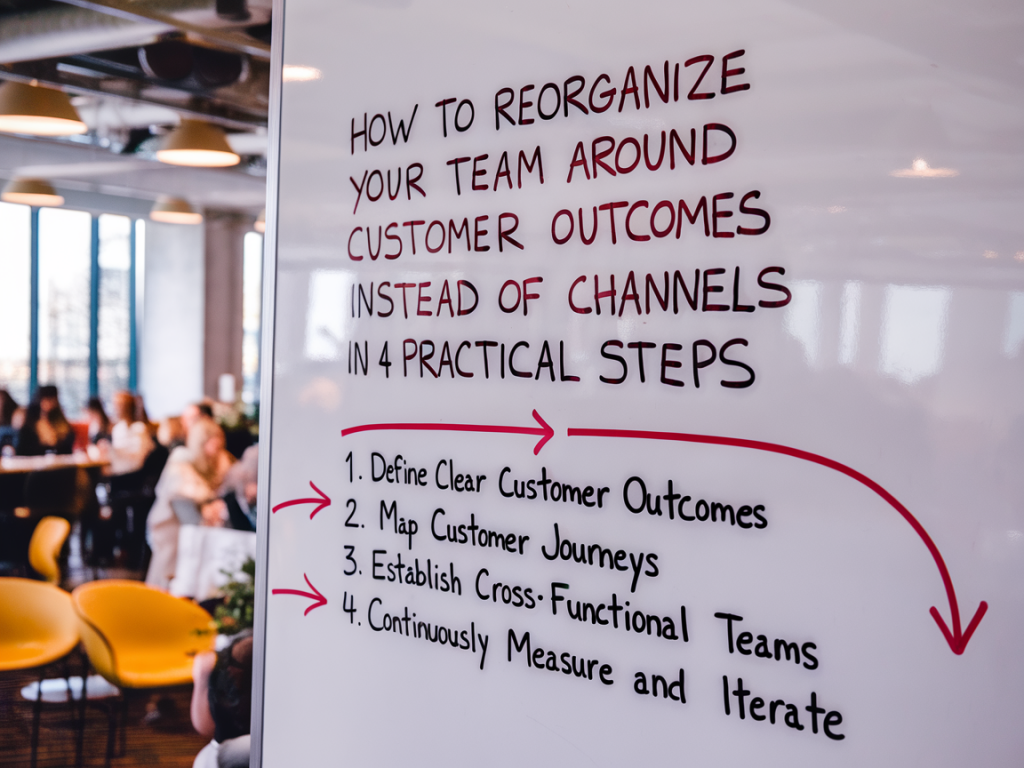
In this piece I’ll walk you through four practical steps I’ve used with SaaS and enterprise teams to reorganize around customer outcomes rather than channels. These steps are intentionally pragmatic: you can start small this week and iterate. I’ll share concrete artefacts, metrics to track, tooling suggestions (I’ve used Zendesk, Freshdesk, Intercom, and Salesforce Service Cloud in different contexts), and common pitfalls to avoid.
Understand and define the customer outcomes that matter
The very first thing I do is run a short workshop to surface outcomes — not activities. You want statements like "customers can get a billing correction within 24 hours" or "new users achieve time-to-value within 48 hours", not "we want to reduce phone volume." Outcomes are customer-centric and measurable.
How I run the workshop:
- I invite 6–8 people across support, product, ops, and sales. Smaller groups move faster.
- We map the top 6 customer journeys (onboarding, billing, technical incident, feature request, account changes, return/refund).
- For each journey we ask: what does success look like from the customer's perspective? How would we measure that? What is an acceptable SLA?
By the end of an hour we have a list of 4–8 outcome statements and candidate KPIs: resolution time, SLA compliance, time-to-first-value, repeat contacts within 7 days, and NPS or CSAT for the journey. These become the north stars for the reorg.
Group work by outcome, not channel — design the squad model
Once outcomes are clear, reorganize people into small cross-functional squads aligned to those outcomes. Each squad focuses on a customer goal and owns the end-to-end experience for that goal across channels. This is the most counterintuitive shift for teams used to silos like "phone team" or "email team", but it’s also the most powerful.
Core squad composition I recommend:
- Squad lead (senior support or product ops) — accountable for the outcome
- 2–4 agents or support engineers — do the day-to-day work
- Product or onboarding rep — brings product context and prioritisation
- Data/analytics owner (can be shared across squads)
- Customer success or account manager (for high-touch accounts)
Squads don't own channels; they own journeys. For example, the "Billing Accuracy" squad will take calls, reply to emails, fix invoices in the billing system, and work with finance to change workflows. This reduces handoffs and encourages ownership.
Practical tip: start with two squads covering your highest-impact outcomes (e.g., Onboarding Time-to-Value and Billing Corrections). Keep other specialists (escalations, platform ops) as shared services to avoid duplication.
Rewire workflows, routing and tooling to support outcomes
Changing org structure without changing workflows is cosmetic. You need routing rules, macros, and automation aligned to outcomes so squads can act quickly. Here’s what to adjust first.
Routing and triage
- Route tickets and conversations based on journey tags, not channel. Use your helpdesk to tag by intent (e.g., "billing_refund", "onboarding_setup").
- Use simple rules: if a request contains invoice number + refund keyword → route to Billing Accuracy squad.
- Keep a fast escalation path to a shared "Critical Issues" team for platform-wide incidents.
Knowledge and playbooks
- Create journey-specific playbooks that include decision trees, fallback messaging, and escalation criteria. Make them short and actionable.
- Embed playbooks inside the agent interface (Zendesk Guide, Confluence snippets, or Intercom Articles) so agents don’t lose time searching.
Automation and self-service
- Automate only where it reduces cognitive load. I often see over-automation that hides context. Use auto-responses to collect key info, not to answer complex queries.
- Invest in guided self-service flows for predictable outcomes (e.g., password resets, invoice downloads). Tools like Typeform, Zendesk Guide, or Intercom Custom Bots work well here.
Table: Example mappings (Journey → Routing Rule → Primary KPI)
| Journey | Routing Rule | Primary KPI |
|---|---|---|
| Onboarding - First 7 days | Tag: onboarding_setup → Onboarding squad | Time-to-first-value (hours) |
| Billing correction | Invoice# + refund → Billing squad | Resolution time (hours), refund accuracy% |
| Technical outage | Priority: incident → Incident response team | MTTR (minutes), customer impact% |
Measure outcomes, iterate, and create incentives
With squads in place and routing aligned, focus measurement on outcomes and create a cadence for continuous improvement. I recommend a simple measurement stack:
- North-star metric for each squad (e.g., onboarding time-to-value)
- Operational KPIs that feed into it (first response time, resolution time, repeat contacts)
- Quality signals: CSAT/NPS per journey, QA scorecards or conversation sampling
- Business KPIs as leading/lagging indicators (churn rate for onboarding, dispute rate for billing)
Weekly rituals
- Squad weekly sync (30 min) to review outcome KPIs, blockers, and customer feedback.
- Monthly cross-squad review to address dependencies and prioritise product fixes.
- Quarterly retrospective to evaluate whether outcomes still map to customer needs — update as necessary.
Incentives and performance
- Align recognition and rewards to outcome metrics, not channel metrics. Celebrate lower time-to-value or fewer repeat contacts rather than raw ticket throughput.
- Use QA rubrics that include outcome-oriented behaviours: ownership, follow-through, and proactive escalation.
Common measurement pitfalls to avoid:
- Rewarding speed at the expense of quality. Track CSAT alongside response times.
- Over-indexing on ticket volume reductions as a proxy for success. Deflection must be meaningful — is the customer happier or just getting ignored?
- Too many KPIs. Start with 2–3 per squad and expand if needed.
Operational example: I worked with a mid-market SaaS company that split onboarding into Success and Technical Enablement squads. Within three months the onboarding squad reduced time-to-first-value from 72 to 36 hours by owning both the welcome messaging and initial configuration checks. They achieved this by adding two autoreplies that collected environment details and routing those straight to the squad, which saved 18 minutes per ticket in triage time and removed a major back-and-forth.
Transitioning to outcome-based teams isn’t a one-off project. It’s a practice of continuously aligning your people, processes, and tools to the customer goals you care about. Start with clear outcomes, form small squads, rewire routing and playbooks, and measure what truly matters — then iterate. If you want, I can share templates for outcome workshops, tagging rules for Zendesk/Intercom, or a QA rubric tailored to outcome metrics.