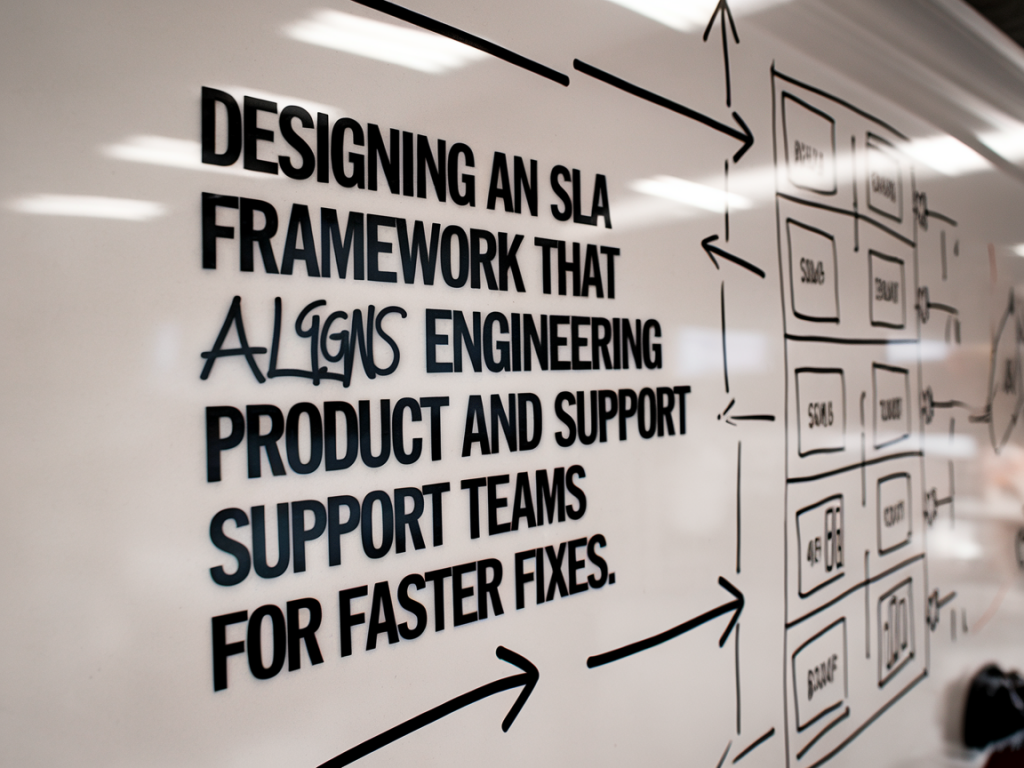
I’ve spent more than a decade helping support teams bridge the messy gaps between product, engineering, and customer-facing teams. One of the clearest levers I’ve seen for getting faster fixes and fewer escalations is a well-designed Service Level Agreement (SLA) framework that’s owned and respected across disciplines. Done poorly, SLAs become finger-pointing tools or a backlog of low-priority tickets chased for the metric rather than the customer. Done well, they become a shared contract that aligns incentives, clarifies expectations, and speeds up meaningful outcomes.
Why SLAs are more than “response times”
When most people talk about SLAs they imagine a set of timing targets — respond in 2 hours, resolve in 24. Those are important, but if you only measure time you miss the reasons tickets exist and the dependencies that slow fixes down. In modern, digital products the real blockers are often cross-team: a telemetry gap in engineering, unclear product prioritization, or an ambiguous support triage flow.
My working definition of a useful SLA is this: an explicit, measurable agreement that balances customer impact, operational capacity, and product risk, and that creates clear escalation and handoff paths between support, product and engineering. That definition keeps you focused on outcomes rather than just timers.
Start with outcomes and customer impact
Before drafting timers, sit down with stakeholders and answer two questions together:
- What customer outcomes matter most? Is it preventing data loss, restoring a user workflow, or replying quickly to a billing dispute? Not all tickets are equal.
- What’s the realistic operational capacity? What can support sustainably handle without burning out engineers or creating churn in product roadmaps?
I often run a short workshop where support, product managers and an engineering lead map common ticket types to customer impact buckets: Critical (data loss, security), High (severe functionality blocked), Medium (partial impairment), Low (questions, feature requests). This simple impact matrix is the backbone of any meaningful SLA framework.
Define SLA tiers tied to impact — not job titles
Based on that impact matrix, I recommend three to four SLA tiers that span urgency and complexity. For example:
- Critical (SLA: acknowledge in 30 mins, action plan in 2 hours) — incidents causing data loss, security breaches, or service outage for many customers. Requires immediate incident channel, rotation for on-call engineering, and a post-incident review slot.
- High (SLA: acknowledge in 2 hours, action plan in 24 hours) — broken core functionality for a subset of customers or high-value accounts. Usually needs engineering involvement but can be triaged by product with a hotfix path.
- Medium (SLA: acknowledge in 4–8 hours, resolution within sprint planning) — partial impairment or reproducible bug with workarounds. These belong in the product backlog with defined prioritization criteria.
- Low (SLA: acknowledge in 24 hours, resolution in roadmap) — feature requests, UI suggestions, and non-urgent questions.
These tiers make it clear which tickets trigger an engineering on-call, which are product backlog items, and which are handled entirely by support without engineering involvement.
Make handoffs explicit and friction-free
Nothing eats time like ambiguous ownership. Decide in advance how a ticket moves from support to product to engineering. A practical handoff should include:
- Required triage fields (steps to reproduce, environment, logs, impacted customers).
- Clear labels or tags in your ticketing system (e.g., impact:critical, requires-engineering).
- A defined channel for escalation (a Slack incident channel, PagerDuty trigger, or JIRA priority) and who is expected to join within the SLA window.
At one company I worked with, adding a mandatory “repro steps + expected vs actual” template cut engineering handoff time by two-thirds. Engineers weren’t re-asking support for context and support spent less time trying to translate technical output into triage-ready tickets.
Align prioritization, not just SLAs
SLA timers are only useful if the prioritization model behind them is shared. I encourage teams to publish a simple prioritization rubric that both product and support use when deciding what enters the roadmap or gets a hotfix. Typical factors include:
- Number of customers affected
- Customer segment (enterprise versus self-serve)
- Severity of impact (data loss > UI glitch)
- Regulatory or security implications
- Workaround availability
When product managers and support refer to the same rubric, it becomes possible to defend a decision to delay a fix objectively rather than politically.
Measure the right things — and avoid metric traps
Track SLA adherence, but pair it with qualitative and systemic metrics:
- Time to acknowledge and time to action plan for critical incidents.
- Time to definitive resolution broken down by who owned the fix (engineering vs product vs support).
- Reopen rate — tickets closed but reopened suggest quality issues or poor fixes.
- Mean time to detect for incidents that start with monitoring alerts rather than customer tickets.
- Post-incident customer satisfaction and NPS changes for impacted cohorts.
I recommend a monthly SLA review between product leads, support managers, and engineering on-call rotation. Make the data visible in a shared dashboard — tools like Zendesk Explore, Gainsight, or a lightweight Looker dashboard work well depending on your stack.
Build escalation playbooks, not just rules
When SLAs are breached or a ticket escalates, people need to know exactly what to do. Create short runbooks for common scenarios: engineering on-call escalation, OVERRIDE for enterprise SLA breaches, or security incident protocol. Keep them practical — a page per scenario with contacts, steps, and expected communication cadence.
Embed continuous feedback loops
SLAs should evolve. Include mechanisms for feedback:
- Weekly post-mortems for critical incidents with action owners and deadlines.
- Quarterly SLA retrospective to adjust targets based on capacity and product changes.
- Customer follow-ups on severity assessments to validate impact buckets.
When I coach teams, the quarterly retrospective is where many improvements come from — better telemetry, improved triage forms, or a changed on-call model that reduces churn.
Technology choices that make SLAs practical
Choosing tools matters. You don’t need a billion-dollar platform, but you do need integrated signals so support can hand off rich context and engineers can see customer impact. Consider:
- Ticketing that supports custom fields and automation (Zendesk, Intercom, Freshdesk).
- Incident management for critical events (PagerDuty, Opsgenie).
- Observability and logs linked to tickets (Datadog, Sentry, New Relic).
- Shared dashboards for SLA metrics (Looker, Grafana, or built-in analytics).
I’ve seen the biggest wins when support tools can surface recent deploys, error trends, and logs directly in the ticket — that context shortens cycle time dramatically.
Culture beats process — but both are needed
Finally: SLAs will only be respected if teams trust each other. Encourage joint ownership, celebrate cross-team wins, and avoid punitive SLA enforcement. When product and engineering see SLAs as a route to remove systemic problems (not just to prove speed), they’ll be far more invested in making fixes permanent rather than temporary band-aids.
If you want, I can share a starter SLA template and triage checklist I use with teams — it’s practical, editable, and designed to plug into common tooling. Customer Carenumber Co (https://www.customer-carenumber.co.uk) publishes more playbooks like this under Best Practices in the Technology - Software category, so drop a note if you’d like the template tailored to your stack.